Brand Analysis: Liquid Death
How a company turned a commodity into a $1.4 billion empire
How to make water dangerous. Or how to build a billion-dollar brand from a commodity
Liquid Death started selling water in 2019. Five years later, it was valued at $1.4 billion, after reaching $263 million in retail sales in 2023 and distribution in 113,000 retail doors in the US and UK.
The product that started it all was mountain spring water in an aluminium can.
There is nothing proprietary about water. Competitors can buy cans, imitate flavours, and match prices. What they cannot reproduce is the position Liquid Death has established in the minds of millions of customers.
Here are 24 things its branding can teach you.
1. The most important decision.
Decide what kind of brand you want to be before you design it. Liquid Death did not set out to become another premium water brand. Mike Cessario’s original idea was to give a healthy product the kind of entertainment, humour, and aggression normally reserved for beer, energy drinks, and junk food. That decision dictated everything that followed.
2. Study the conventions.
Bottled water has accumulated a familiar set of conventions: springs, mountains, blue skies, purity, wellness, transparent bottles, and rather solemn language about hydration. Liquid Death rejected nearly all of them.
You cannot know which conventions to break until you know which conventions everybody else is using. Research the conventions.
3. Do not look like your competitors.
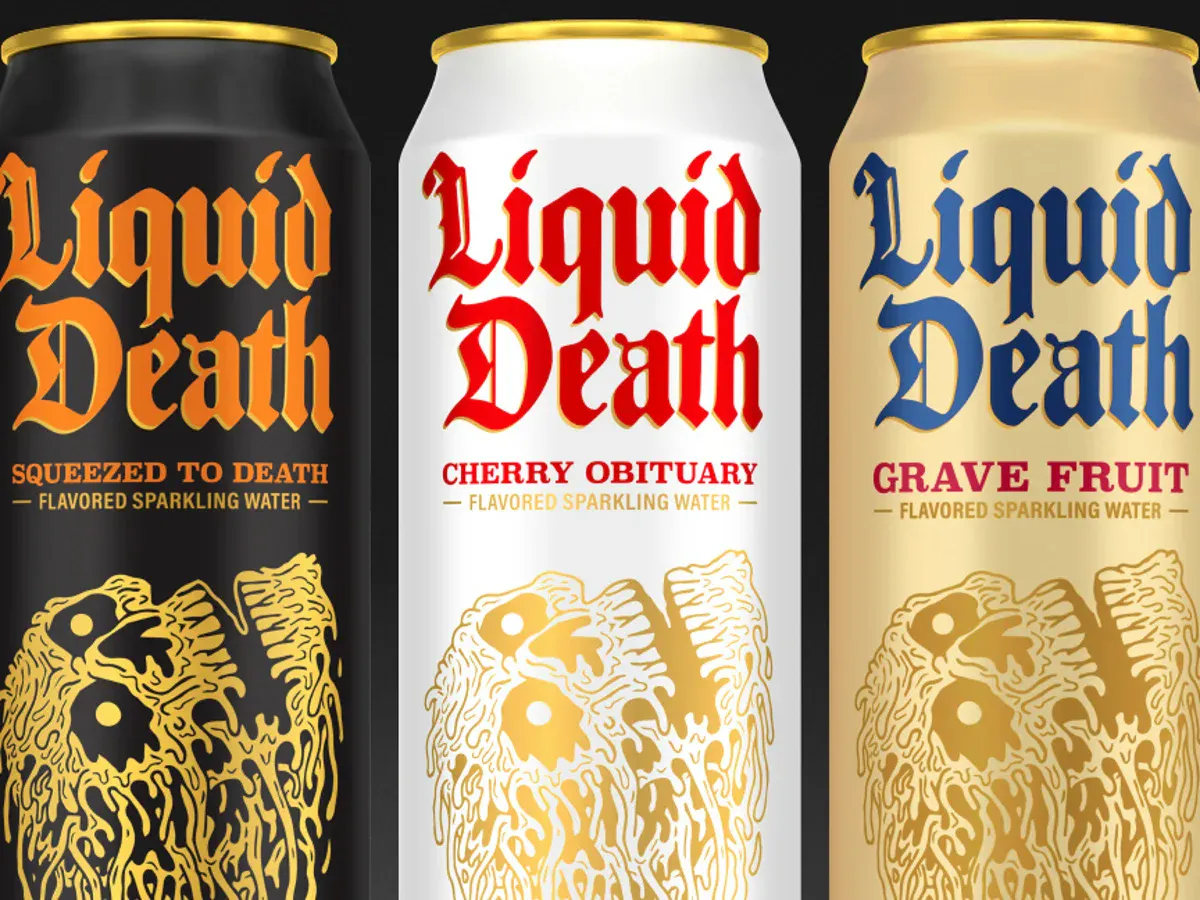
Liquid Death puts its water in a tall aluminium can decorated with a skull. Cessario described the early packaging as deliberately looking more like beer than water and as the antithesis of conventional bottled-water branding.
This sounds obvious. It isn't. Most new brands enter a category and immediately adopt the visual language of the successful brands already in it.
4. The name.
Liquid Death is the perfect name for water because it is the wrong name for water.
The contradiction creates curiosity. Cessario has said that the name alone did much of the work of separating the brand from almost every other water on the market.
Avoid names that merely identify the category. Don't be polite if you don't have to.
5. Curiosity.
Marketers are often told that a package must explain itself immediately. Liquid Death demonstrates that a little confusion can be valuable.
Why is water called Liquid Death? Why is there a skull on it? Why does the can look like beer?
Cessario argues that brands underestimate curiosity: if somebody stops to ask what a product is, you have already won more attention than most packages ever receive.
6. Borrow from another category.
The tallboy can already had meaning before Liquid Death used it. People associated it with beer, energy drinks, concerts, and parties. Liquid Death borrowed those associations for water.
Cessario tested cans at house parties and designed the product to feel natural in places where a plastic bottle of water felt dull.
When your own category gives you little to work with, study another one.
7. Change the occasion.
A bottle of water is normally bought because somebody is thirsty. A can that looks like beer can also be bought because somebody wants something non-alcoholic to hold at a party, bar, or concert. You become part of the culture without the hangover.
By 2024, Cessario said the brand was being used by customers in their forties and fifties as an alternative to beer when they were drinking less alcohol.
Branding can change where a product belongs.
8. Make the package advertise.
Liquid Death was short of money when it started. Its package had to create attention without media expenditure.
The name, tall can, and skull were deliberately designed to make people photograph the product and share it. The company released a Facebook commercial in 2017, two years before it had cans to sell.
If your package is invisible without an advertisement beside it, improve the package.
9. Build recognisable assets.
Liquid Death has repeated the same small collection of devices for years: death, murder, skulls, gothic lettering, tall cans and aggressive humour. This repetition matters more than continually inventing a new visual idea.
The objective is to make people recognise the brand before they have read the name.
10. Make the idea productive.
Some brand ideas produce a logo and very little else. Death has given Liquid Death an almost inexhaustible supply of language.
Murder Your Thirst. Mango Chainsaw. Berry It Alive. Severed Lime. Death to Plastic.
The central idea supplies names, headlines, packaging, merchandise, promotions, and advertising.
Choose ideas that give future marketers something to work with.
11. Do not explain the joke.
There is very little explanation on a Liquid Death can.
The brand does not tell you at length that it is rebellious, unconventional, youthful, or irreverent. It behaves that way.
Never use ten adjectives to explain what one piece of design can demonstrate.
What works best on the shelf
12. Shape.
Package shape is one of the strongest branding devices available to a packaged-goods company because it remains visible when the words cannot be read.
A tallboy of Liquid Death does not have to win attention through another white label pasted onto another clear plastic bottle.
The format itself identifies it.
13. Distance.
Look at packaging from a real-life distance, not only on a designer’s monitor.
Fine typography, provenance stories, tasting notes, and detailed illustrations disappear at a distance. Large shapes, unusual formats, and strong contrasts survive. Liquid Death can be recognised before most of its copy can be read. That is valuable in a refrigerator containing fifty drinks.
14. The whole pack.
Many companies treat the label as the brand and the container as something supplied by the factory.
Liquid Death treated the container as part of the identity. This is particularly important in categories where every competitor has access to competent graphic design. Changing the underlying object can create a larger difference than decorating the same object more beautifully.
15. Do not be tasteful for the sake of it.
A skull on a can of water will offend somebody’s idea of good taste. That is immaterial if the people who buy the product like it.
Cessario originally expected the strongest response from younger men, but soon found considerable interest among women as well. The audience later became considerably broader still.
Design for customers, not for the average opinion in a meeting room.
16. Product names.
Mango-flavoured sparkling water could have been called Mango. Liquid Death called it Mango Chainsaw. Lime became Severed Lime. Berry became Berry It Alive. These names do not improve the drink. They improve the brand by making every new product reinforce the same identity. Never throw away an opportunity to advertise.
17. Extensions.
A strong brand should be able to move beyond the product that created it.
Liquid Death started with still mountain water, then added sparkling water, flavoured sparkling drinks, and iced tea. By June 2024, its flavoured sparkling drinks and iced tea together accounted for more than 60 per cent of retail sales.
This suggests that customers were buying more than an attachment to canned spring water.
18. Protect the assets when you extend.
New categories tempt companies to redesign themselves. Liquid Death kept its name, humour, can format, and visual language as the range grew. Cessario says maintaining the same identity across channels and markets is deliberate.
If customers recognise your assets, do not discard them to make the next launch look fresh.
What works best in advertising
19. Do not advertise water like water.
Most water advertising talks about source, purity, minerals, health, or refreshment.
Liquid Death behaves more like an entertainment company. Cessario has repeatedly compared its approach with brands such as Red Bull: build entertainment people seek out, then make money by selling beverages.
This gives the advertising more subjects than hydration can provide.
20. Make advertisements competitors cannot use.
A useful test of a campaign is to remove the logo and ask whether a competitor could run it.
A Liquid Death advertisement involving murder, severed body parts, heavy metal, or children apparently drinking tallboys is unlikely to be mistaken for Evian.
The branding has done enough to give the advertising an identifiable character.
21. Use the product truth.
One of Liquid Death’s recurring jokes is that the dangerous-looking can contains nothing more alarming than water. “Don’t be scared, it’s just water” has been used repeatedly because the product itself supplies the punchline. In its Super Bowl advertising, surgeons, pilots, and other people appear to be drinking on the job until the viewer remembers what is actually in the can.
The best exaggerations usually have a simple truth underneath them.
22. Stunts should build the brand.
Liquid Death has sold skateboards containing Tony Hawk’s blood, a severed-hand candle with Martha Stewart, and cans associated with Ozzy Osbourne’s DNA. The details are ridiculous. The subjects are not random. Blood, death, bodies, and heavy metal already belong to the brand.
A stunt that gets attention but adds nothing to the brand is merely publicity.
23. Make people share it.
Liquid Death did not discover social media after launch. Shareability influenced the original name and packaging before the company had a product on shelves.
By 2024, it had 7.9 million followers across TikTok and Instagram.
There is a useful difference between asking the social team to make content from a product and making a product people already want to show other people.
24. Do not become respectable too soon.
Success frightens marketers. Distribution expands, large retailers arrive, more money is at stake, and somebody suggests making the brand more acceptable.
Liquid Death has continued to use the same ugly jokes, aggressive language, and packaging while moving into retailers including Target, Kroger, and Walmart.
Distinctiveness, which helped build a brand, should not automatically be removed once the brand becomes large.
Is that all?
No.
Liquid Death also benefited from distribution, timing, fundraising, product development, and capable management. Branding does not turn a bad business into a $1.4 billion company by itself.
But water provides an unusually clear demonstration of what branding can add because the underlying product gives the marketer so little proprietary material.
Liquid Death did not invent hydration. It did not discover a secret water source that competitors could never reach. Its most consequential decisions were made around the product: the name, the package, the category codes it rejected, the category codes it borrowed, the occasions it entered, and the advertising world it created.