This is the story of two queues that showed up in Belfast. One dissolved within weeks. The other is still there.
The Department noticed that two long queues showed up in Belfast. One dissolved within weeks. The other is still there, requiring a deeper investigation.
Popeyes
The American fried chicken chain that became famous for its chicken sandwich, the one that broke social media in 2019 and caused real fights in drive-throughs across the US. In late 2024 it opened on Forestside Shopping Centre. With security managing the line, a crowd of 180 people stretched around the corner, creating the kind of scene that generates local news coverage and gets posted and reposted all week. For the first few weeks, every time you passed, people were waiting. Then the queue got shorter. Then the security guard and the queue were gone. The restaurant is still trading, presumably doing fine, but the spectacle passed quickly.
Sephora
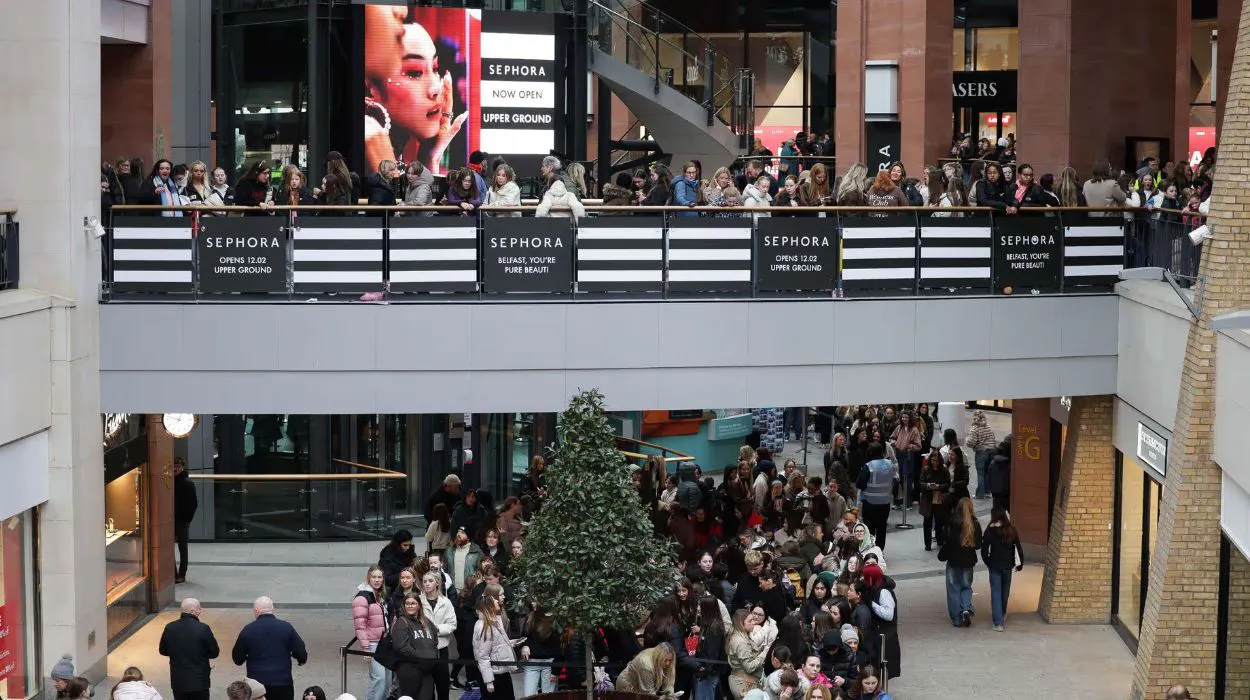
Sephora arrived in February 2026. The day it launched, the queue was 1800 people long. While the queue certainly got shorter, it held. Well past opening weekend, months in even, people are still lined up outside with a security guard at the door.
Before trying to explain that, it's worth looking at what's actually on the surrounding streets. MAC has been in Belfast for years. A premium makeup brand with real brand loyalty, products that professionals use, a customer base that shops there repeatedly. Walk straight in. Kiko is also around the corner from Sephora. Good makeup, well-priced, a full range. Walk straight in. Three stores in the same product category, within a short distance of each other, two of them fully accessible, one of them with a security guard regulating the door. And the one with the security guard is the one people are queuing for.
The easy explanation is that Sephora is Sephora, that the brand has a cultural depth and a global reputation that MAC and Kiko don't, that people have been watching Sephora hauls on YouTube for years and the queue is the expression of a long-distance relationship finally going local. There's truth in that. But it doesn't actually hold up as the complete answer, because MAC has cultural depth. MAC has loyal customers who identify with the brand. MAC has been a fixture in professional makeup and beauty culture for decades. And yet when the Sephora queue forms outside, nobody is queuing for MAC.
The variable isn't just culture. It's the security guard.
What Sephora did, deliberately or otherwise, is keep the architecture of scarcity in place after the initial rush. The bouncer stayed. The capacity limit stayed. The result is that every person walking down that street receives the same signal, day after day: what's inside is worth controlling access to. That signal is doing enormous brand work, and it costs the price of one security guard's hourly rate.
There's a psychological mechanism running underneath all of this. Desire doesn't really follow scarcity. It follows the signal of scarcity. When you see a queue managed by security outside a store, your brain doesn't perform a rational assessment of whether the product inside is objectively superior. It runs a shortcut: if other people are willing to wait, and if someone has decided access needs to be controlled, then whatever is happening in there must be worth it. The queue creates the desire as much as the desire creates the queue. Once that loop is running, it's self-sustaining.
Popeyes had the loop running too, in those first few weeks. But at some point they made the obvious operational decision to just let people in, to clear the backlog and run the restaurant normally. Which is the entirely sensible thing to do if you're thinking about throughput and customer experience. And it killed the signal. The moment the queue dissolved, so did the perception of scarcity, and with it went the theatre that was broadcasting desirability to everyone passing on the street. If they had kept the security presence, kept the capacity limits, kept the queue visible even as actual demand normalised, you'd probably still see people outside Popeyes today. The chicken sandwich would feel different. And so would the experience of eating it, because you'd have waited for it, and the waiting would have done its own quiet work on how you perceived the thing at the end of it.
This is what brands so rarely understand about their own launch moments. The initial queue is a gift. It's free social proof, broadcast publicly, telling the street that something worth wanting is happening inside. Most brands treat it as a logistical problem to be solved as quickly as possible. Get the queue down, improve the flow, stop the wait. All of which is rational from an operations perspective and completely counterproductive from a brand perspective, because the queue was the most valuable thing you had.
MAC walks you straight in because MAC thinks of itself as a retailer. Sephora, whether by design or happy accident, is running a different operation. The store is also a stage, the queue is part of the show, and the security guard is not managing capacity. He's managing perception.