The Brand Story of Supreme
Downtown New York in the early 90s. Skating, hip hop, hardcore punk and graffiti. This is where Supreme was born.
The skate shop that made you come to it
You have to understand the context first, because without it the Supreme story sounds like a fluke. Downtown New York in the early 90s had a specific cultural ferment going on. Skating, hip hop, hardcore punk and graffiti had all crashed into each other in lower Manhattan and fused into something new. The kids living inside that world had built their own hierarchies of cool, with their own sense of who belonged. And the brands supposedly serving them were getting it wrong, doing that thing where a large company tries to approximate street credibility and produces a corporate cosplay the actual culture finds embarrassing.
James Jebbia had been marinating in that world for years. Born in America, raised in England, came back stateside and worked at Parachute in SoHo before helping open the New York Stüssy store, which in the early 90s was about as credible as retail got. By April 1994, when he signs the lease on 274 Lafayette Street, he already understands the people he wants to build for. He knows the customer, what that customer thinks about authenticity, and how quickly they'll turn their back on anything that feels even remotely manufactured.
The store
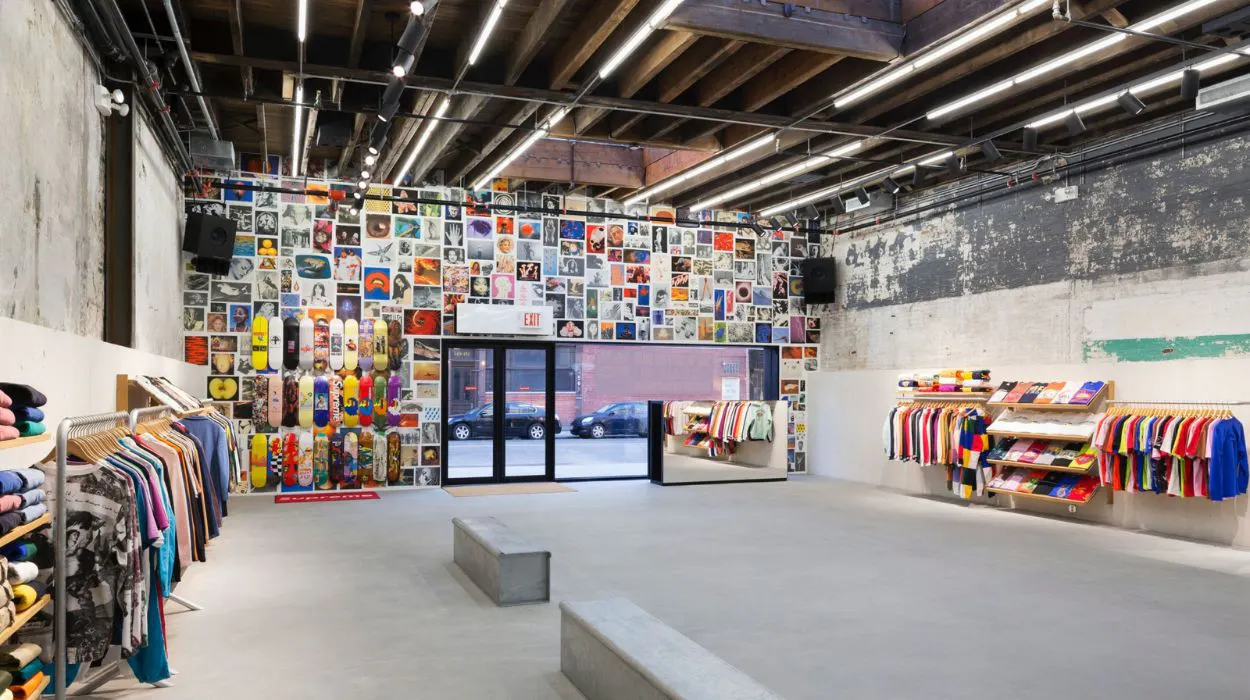
The store design was a thesis statement. Racks along the perimeter, and an open floor in the middle with enough space to skate through the place. The space belonged to the people who used it. The staff were skaters from the downtown scene, embedded in the culture, with real opinions and zero inclination toward performing customer service warmth at someone who walked in with outsider energy. If you belonged, you felt it immediately. If you were an outsider, you felt that too, and Jebbia left that friction exactly as it was.
The standard retail playbook says to reduce friction at every point. Make entry easy, make everyone feel welcome, broaden the audience. Jebbia ran a different logic. The discomfort of entry was the product. The exclusivity of atmosphere was what made the people who did belong feel the full weight of belonging. Flatten it out, make it comfortable for everyone, and you've dissolved the thing that made the store worth going to. So the intimidating staff and gatekeeping energy stayed. The skaters treated Lafayette Street as theirs, kept coming back bringing their world with them, and kept the culture alive inside the store in a way a warmer environment could never have sustained.
A red box
The logo is one of the more interesting visual identity stories in recent brand history. Barbara Kruger, an American conceptual artist whose activist work in the 80s used stark red-and-white compositions with Futura Heavy Oblique text, later observed a striking resemblance between her visual language and Supreme's box logo. The resemblance is undeniable. Supreme had taken the formal vocabulary of activist art and applied it to commercial product, which carries its own irony given that Kruger's work was often a critique of consumerism. She's expressed understandable frustration about it. But the logo became remarkable for reasons that had little to do with its origins and everything to do with what the culture did with it.
A red rectangle with white Futura text communicates nothing in isolation. It borrowed meaning entirely from the world around it, and as that world grew in cultural weight, the box became a vessel. By the time Supreme was global, putting that logo on essentially any object, a crowbar, a cash register, a Bible, an actual clay brick, was sufficient to transform the object into something people would queue for. The design had become a blank canvas the culture continuously painted value onto.
Thursdays
The weekly drop is the mechanism that explains everything else. From those early Lafayette Street days, Supreme released new product on a set schedule. Thursdays, small quantities, finite window. To buy something required you to be paying attention, ready to move when the window opened. That inverted the usual power relationship between brand and customer. Every other retailer was chasing the customer's attention and making itself as convenient as possible. Supreme required the customer to structure their behaviour around its schedule, which communicated an enormous amount about the value of what was being sold before anyone had even looked at the product.
The Thursday ritual created something like a standing appointment in the consciousness of anyone invested in the brand. The anticipation built across the week. The drop felt like an event with genuine stakes. And because quantities were limited, copping something carried real signal value. It confirmed you were close enough to the culture to know when things were dropping and committed enough to show up. Over time the queue became its own spectacle. People planned around it, then camped for it, then flew internationally to be part of it. The line outside Lafayette Street on a Thursday became a recurring live performance of desirability, visible to everyone passing, long before influencer culture existed as a formalised mechanism.
The scarcity was genuine in the early years. As the brand scaled, it became deliberate. Supreme could have produced larger runs, the demand was there. Holding quantities tight protected the psychological architecture that made the whole thing function. They had figured out that the wanting, the anticipation, the slightly-out-of-reach quality, was more powerful brand fuel than the having. Lots of brands have loyal customers. Supreme had customers who organised their weeks around the possibility of buying.
Silence
Their relationship with advertising is almost the inverse of how the industry operates. While other brands built entire departments around social media, content production and paid media, Supreme maintained something close to studied indifference. Sparse Instagram, minimal advertising, a website that for years was essentially a near-blank page with a small shop embedded quietly within it. That restraint was widely misread as aloofness, but it was a sophisticated understanding of how brand desire operates.
The moment a brand starts explaining itself, starts reaching outward to find its audience, it emits a signal its core audience immediately detects and discounts. Cool audiences are exquisitely sensitive to effort. Supreme let the culture do the carrying, through the queues, through organic association with credible people in music and skateboarding, through resale prices that updated daily as public evidence of demand. The culture was an amplification engine paid media could only dream of matching.
Collaboration
Collaborations became the other major pillar, and the logic was more interesting than the surface read. The obvious version is two brands with overlapping audiences make something together and everyone wins. Supreme did something more elaborate. They used collaboration to create deliberate cultural collisions, pairings so unexpected the pairing itself became the story.
The Louis Vuitton arc has a strange shape. For years Supreme had been producing pieces that played with LV's monogram, putting it on skateboards and accessories in ways LV's legal team found objectionable. Cease and desist letters were sent. Real antagonism existed. Then in the mid-2010s the dynamic shifted, and LVMH's men's creative director Kim Jones came to Supreme with a proposal to do it officially. The 2017 collaboration launched at Paris Fashion Week with a full runway show. Supreme product appeared inside Louis Vuitton flagships. Pieces hit resale within hours at multiples of retail. The brand that had been sending legal threats a few years earlier had handed Supreme one of the most prestigious stages in fashion. That reversal in power dynamic is a clean illustration of where cultural credibility had moved by the second decade of the 2000s.
The North Face partnership operated on different logic and became one of the most durable in the catalogue. The North Face carries genuine technical credibility in outdoor gear, but it also had deep roots in hip hop and street culture going back to the 90s, worn in Harlem and East New York long before it became a suburban outdoor brand. Supreme collaborating with them was a confirmation of shared cultural territory. Limited colourways, updated cuts, the box logo on performance outerwear turned functional product into something people would queue through a winter night to own. The partnership ran annually for over a decade and never exhausted itself, partly because the product was good and partly because the cultural logic held up on inspection.
Then there's the brick. In 2016 Supreme released a red clay brick embossed with the box logo. Thirty dollars retail. It sold through immediately and appeared on resale for $200 and beyond shortly after. This is the most concentrated demonstration of the brand's logic in a single object. A clay brick is, on its own terms, an unremarkable purchase. A Supreme brick exists in a different category entirely. It's a proof of concept, evidence that the box logo alone is sufficient to transform any object into a sought-after artefact. The brick was always about the idea.
Tokyo
Japan tends to get underplayed in the Supreme story, but it was formative. Supreme opened its first store outside the US in Daikanyama, Tokyo in 1998, four years after Lafayette Street, when the brand was still a contained downtown phenomenon by any global measure. Japanese youth culture in the late 90s had a sophisticated relationship with American street culture, particularly anything connected to skating and hip hop in New York. And Japanese consumer culture already had elaborate rituals around limited edition product, around queueing, around the social significance of owning something produced in finite quantities, practices that still felt radical in the US but were already a familiar language in Tokyo. Supreme found a ready readership. The Tokyo stores became cultural anchors in their own right, genuine nodes in a global network rather than outposts, which proved the model could travel and reinforced the mystique at home.
Earned association
Celebrity association is part of the story but it operated almost entirely outside the usual mechanisms of endorsement. In the early years there were no contracts, no seeding arrangements, no calculated placement. Supreme had built something real inside the cultures those people came from, so the associations were organic. Old photographs of Mike Tyson in Supreme gear in the mid-90s. Morrissey wearing a box logo tee. Members of Dipset and various New York music scenes representing the brand through the early 2000s. A brand can pay for a face and a caption. What it actually wants is someone's genuine enthusiasm, which is visible in a completely different way and carries completely different weight with the people watching. Supreme accumulated the second kind because it had earned it.
The resale economy that formed around Supreme is worth understanding as a distinct component, because it does something Supreme could never manufacture directly. When a piece drops on Thursday and appears on StockX an hour later at three or four times retail, that price discovery happens publicly, and the price becomes a signal. It tells everyone watching this matters, this is sought after, this is worth more than its face value. Supreme gets to maintain retail prices accessible enough to sustain the mythology of a brand built for skaters, while the secondary market communicates values that tell a different story. The brand gets both signals at once, and the resale economy generates them for free.
The establishment
In 2017 the Carlyle Group, one of the most powerful private equity firms in the world, took a minority stake in Supreme at a valuation of around a billion dollars. The irony of a brand born from anti-establishment skate culture being partly owned by that institution was widely noted. Then in 2020 VF Corporation, parent company of Vans, Timberland and The North Face, completed a full acquisition at $2.1 billion.
The acquisition raised real questions about whether Supreme could survive as itself inside a corporate structure, and those questions haven't fully settled. There are people who'll tell you something shifted after the VF deal, that the drops felt more calculated, the collaborations more legible to a mainstream audience, the energy slightly less volatile. Maybe. The mechanisms Jebbia built over thirty years are embedded deeply enough that they proved durable even as ownership changed. The box still carries weight. The Thursday still means something to a specific kind of person. But the tension between commercial scaling and the thing that made the brand valuable is a live question, and genuinely unresolved.
Secondary
What Supreme built was a model where exclusivity and desire reinforce each other over time rather than burning through. Every conventional growth framework says to broaden appeal as you scale, make it accessible, find the mass market, let more people in. Supreme ran the opposite thesis for three decades. Stay specific, hold the scarcity, keep the slightly-out-of-reach quality intact. By refusing to come to its audience, by requiring the audience to come to it, the brand became one of the most talked-about in the world.
The deeper product was the feeling of being inside something. Of being one of the people who knew the schedule, who moved at the right moment, who understood what they were part of. The box logo, the Thursday drop, the international collaborations, the gatekeeping staff, all of it was infrastructure in service of manufacturing that feeling reliably, across thirty years, out of a skate shop on Lafayette Street where you could roll through on your board if you knew what you were doing.